The Genie Still Interprets the Wish: Why "AI Replaces People" Is Overhyped

Here's a thought experiment I keep coming back to whenever someone tells me AI is about to replace half the workforce. Ready?
On pure compute, replacing the accountant is easier than replacing the janitor.
Pause on that, because the instinct is to read it backwards. The accountant is the white-collar one, the "knowledge worker," the prestige job. The janitor is the blue-collar one, the so-called "low-skill" work. Surely if any technology comes for jobs, it comes for the bottom of the ladder first, right? That's the story the entire industrial revolution conditioned us to expect.
Look at it from the machine's side, though. What does an accountant actually do? Fixed inputs, fixed rules, numbers in, numbers out, mostly through software that already exists. Reconcile invoices. Run payroll. Categorize transactions. File the same forms quarterly. Most of it is structured data flowing through structured systems. That is exactly the shape of problem a GPU is good at. No body required. No physical world required. Just compute.
Now look at the janitor. Empty trash, mop floors, restock toilet paper, deal with a stairwell someone threw up in at 2am. Every shift is a new layout, a new set of obstacles, a new mess in a new place. You can't solve that with software alone you need a body in physical space, traversing irregular environments, manipulating objects of unpredictable shape and weight, and doing it cheaply enough to beat $15-22/hour. GPU + robot. Two stacks, not one. And the robot half is where the math falls apart.
The Unitree G1, the cheapest "full-featured" humanoid you can actually buy right now, sells for $13,500 on Unitree's official store. Sounds promising. Until you read the next sentence: real-world efficiency for humanoid robots in 2026 is "typically 30–70% of human productivity", and total cost of ownership adds another 20 - 40% to the purchase price in maintenance, insurance, training, integration. That's the cheap one. The robot that can actually handle an unpredictable janitorial route the Boston Dynamics Atlas tier runs under $320,000 with commercial production just beginning in 2026. Tesla, the most aggressive price disruptor in the humanoid space, admits Optimus "currently operates at less than half the efficiency of a human" in its own factories. The robotics math gets worse the more variable the environment, which is why the warehouses with predictable floor plans are seeing deployment and the office buildings with weird stairwells are not.
So on paper, the accountant is the easier replacement target. Pure compute problem, no physical embodiment needed.
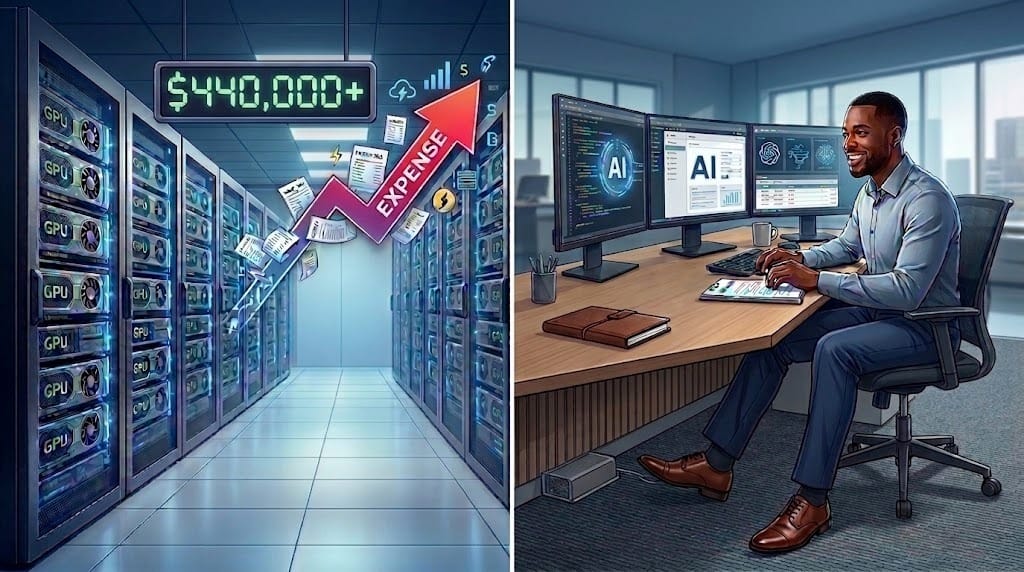
Here's the twist: even the accountant isn't getting fully replaced right now, and that's the part the hype cycle doesn't want to tell you. Running a real agentic AI workflow one that can actually do an accountant's job end-to-end, not just draft a memo burns serious GPU. Inference at scale, multi-step reasoning, tool use, error correction, the full stack. When you total up the API costs or the data center amortization for the compute you'd need to fully replace a $75K-a-year accountant who works 2,000 hours, you still haven't beaten the human on price. Not yet. The GPUs are still more expensive to operate than the person doing the work.
Which means the actual play companies are running in 2026 is not replacement. It's something messier.
What companies are actually doing (and it's not what the headlines say)
The hype cycle wants you to believe two contradictory things at once: AI is going to replace everyone, and every company that does layoffs is doing it because of AI. The data tells a much funnier story.
In 2025, companies directly attributed 55,000 job cuts to AI more than 12 times the number from two years earlier, according to Challenger, Gray and Christmas. That sounds catastrophic until you realize total layoffs that year were over 1.2 million meaning AI was named as the reason for 4.5% of job cuts. The other 95.5%? Overhiring, restructuring, financial pressure, weak demand. The boring stuff. The stuff CEOs really, really don't want to put on the earnings call.
Which is why we got a new term: AI washing. A Babson management professor put it bluntly: employees cite AI in layoff announcements because it's "the least bad reason companies can use." Blame tariffs? Wall Street panics. Blame overhiring? Investors ask why you didn't manage your headcount. Blame AI? You sound innovative. Resume.org found nearly 60% of hiring managers admit they emphasize AI's role in layoffs because it "is viewed more favorably than financial constraints."
Even Sam Altman who probably benefits more than anyone alive from "AI is replacing workers" being true said the quiet part out loud at the India AI Impact Summit: "there's some AI washing where people are blaming AI for layoffs that they would otherwise do." When the guy selling the genie tells you not everyone wishing on it is being honest about why, listen.
Amazon was the cleanest example. CEO Andy Jassy initially leaned hard into the AI-replacement narrative when announcing 30,000 corporate job cuts. He later clarified that the cuts were "not really AI-driven, not right now at least." The cuts still happened. The reason just wasn't the one that sounded best to shareholders.
Big companies: AI as a workload multiplier, not a labor replacer
Here's what's actually happening inside the Fortune 500 right now, and it's the part the headlines miss entirely.
Big companies are not, by and large, replacing workers with AI. They're doing something much more cynical and much more profitable: they're using the fear of AI to extract more work from the employees who survive each round of cuts.
Think about it from inside the building. Your company just laid off 8% of the org and put out a press release about "AI-driven efficiency gains." You still have your job. What do you do? You work harder. You learn the new tools. You take on the redistributed workload from your laid-off coworkers without complaint because and this is the unspoken part you are terrified you're next. The fear does more work than the AI does.
Yale's research framed it precisely: "Firms are not cutting headcount but are getting more output from the same workforce. As productivity rises, the need for new recruits falls. Existing employees reskill. Advertised roles go unfilled and hiring slows." The disruption isn't mass firings. It's a slow squeeze on the existing workforce combined with a hiring freeze for new people.
That second part is where the real human cost lives. Goldman Sachs estimates AI is reducing U.S. employment by roughly 16,000 jobs per month not through layoffs, but through hires that never happen. Roles that get posted and quietly killed. Entry-level pipelines that close. "The first jobs to disappear are often outsourced call centers, agencies, and offshore support. That makes the early impact easy to miss."
So the headline version "AI is replacing people!" is wrong in an important way. The accurate version is: AI is making existing employees do the work of 1.3 people while making it harder for new people to get hired in the first place. That's not the robot apocalypse. It's something older and more familiar: management using a technological excuse to extract more labor for the same wage.
Small companies: the opposite story nobody is telling
Now flip the script. Walk into a 12-person company in Miami, Tampa, or anywhere that isn't a tech hub, and the story is completely different.
Pick almost any specialized B2B space procurement, niche professional services, regulated industries with heavy documentation requirements. Pre-2023, the unspoken rule was the same everywhere: the big incumbents will eat you alive on anything serious because they have a 200-person proposal team and you have you. You couldn't write the response document fast enough. You couldn't price the bid with enough precision. You couldn't keep up with the compliance paperwork. The size barrier wasn't legal it was just operational gravity.
That gravity has gotten a lot weaker.
A solo founder with Claude, ChatGPT, Gemini, and a half-decent prompt library can now generate the kind of response document that used to require three people and a week. Not as polished as the big incumbents? Sure. Polished enough to compete? Absolutely. And here's the thing the doomer takes miss: when small companies can suddenly compete in spaces they were locked out of, they don't shrink. They hire. They have to. The work expands faster than the AI can handle alone, because winning the bid means executing the bid, and execution is still mostly human.
This isn't theoretical. IBM has reportedly tripled its entry-level hiring in 2026, saying that while AI can do many entry-level jobs, it still needs a human touch. Furthermore, while cutting entry-level jobs would deliver short-term savings, it comes with the risk of erasing the pipeline needed to train future experienced workers and mid-level managers. EU data shows that companies that deployed and invested in AI are hiring more, not less.
And the broader labor market backs it up. The April 2026 jobs report showed 115,000 jobs added the second straight month of gains. After 2025 averaged an anemic 10,000 per month, 2026 is now averaging 76,000. The "AI is destroying jobs" narrative has to contend with the fact that the labor market is healing, just unevenly. White-collar office work is squeezed. Healthcare, transportation, warehousing, trades booming. Including, ironically, a surge in demand for skilled electricians and technicians as part of the AI infrastructure build-out. The AI boom is creating physical-world jobs faster than it's eating software ones.
The genie metaphor, for real
So here's where the title comes in.
You can't put the genie back in the bottle. AI is here, it's getting better, and the cost curve is going the wrong way for "AI is too expensive to use to replace an employee 1 for 1." That's settled. The question is not whether to use it. The question is what you wish for.
If you wish from scarcity cut the workforce, cut costs, beat the competitor, look innovative to investors the genie will absolutely grant that wish. And the way it grants it is the way wishes always get granted in the stories: technically correct, but you may not like the final outcome. You lay off the wrong people. You hollow out your training pipeline. You extract enough extra labor from your remaining staff that the good ones leave on their own. You "save" money on headcount and pay it back in turnover, missed institutional knowledge, and a culture of quiet terror that makes your AI tools less effective because nobody wants to flag a problem the AI created.
If you wish from abundance do the work better, expand into spaces we couldn't reach before, let our people do more of what they're good at, build something that didn't exist the genie grants a different wish. You use AI to remove the parts of jobs nobody liked doing anyway. You let your accountant skip the data entry and spend more time on the analysis they got into the field for. You let your engineer skip the boilerplate and focus on the architecture. You let your small business compete with the giants and hire the people who got laid off from those giants for the wrong reasons. You make the work more human, not less.
The genie doesn't care which one you pick. It interprets what you ask for. That's the part the hype cycle keeps missing the technology is morally neutral, but the wishes aren't.
What this actually means in 2026
A few practical takeaways:
For employees at big companies: assume your "AI-driven layoff" was probably going to happen anyway. Don't take it personally and don't believe the press release. The skills that survive this aren't the ones that compete with AI on speed they're the ones that compete with it on judgment, relationships, and physical presence.
For small business owners and solo operators: this is your moment, and it has a shelf life. The gap between "AI tools are cheap enough that a one-person shop can act like a ten-person shop" and "AI tools are good enough that a one-person shop is a ten-person shop" is the window you're in right now. Use it to grow into work you couldn't previously touch, then hire the humans you need to actually execute it.
For executives reading the same Anthropic and Goldman Sachs reports as everyone else: the productivity gains are real, but the labor savings number you put in the slide deck is fiction. Plan for AI as a force multiplier on your best people, not a replacement for your worst. Cutting your training pipeline to save 4% on payroll is the most expensive decision you'll make this decade.
For anyone catastrophizing on Twitter: the GPU still costs more than the accountant, and the robot still falls over before it gets the janitorial job done. The AI still hallucinates a citation in your legal brief. We're a long way from the world the hype is selling, and probably further than most CEOs claiming "AI-driven efficiency" want you to know.
Embrace the tool. There's no putting the genie back in the lamp. Just be deliberate about what you wish for because the genie always, always interprets the wish.
And right now, the wishes being made from scarcity are doing more damage than the technology itself.