The AI Doom Cycle Is Back, and It’s Still a Sales Pitch

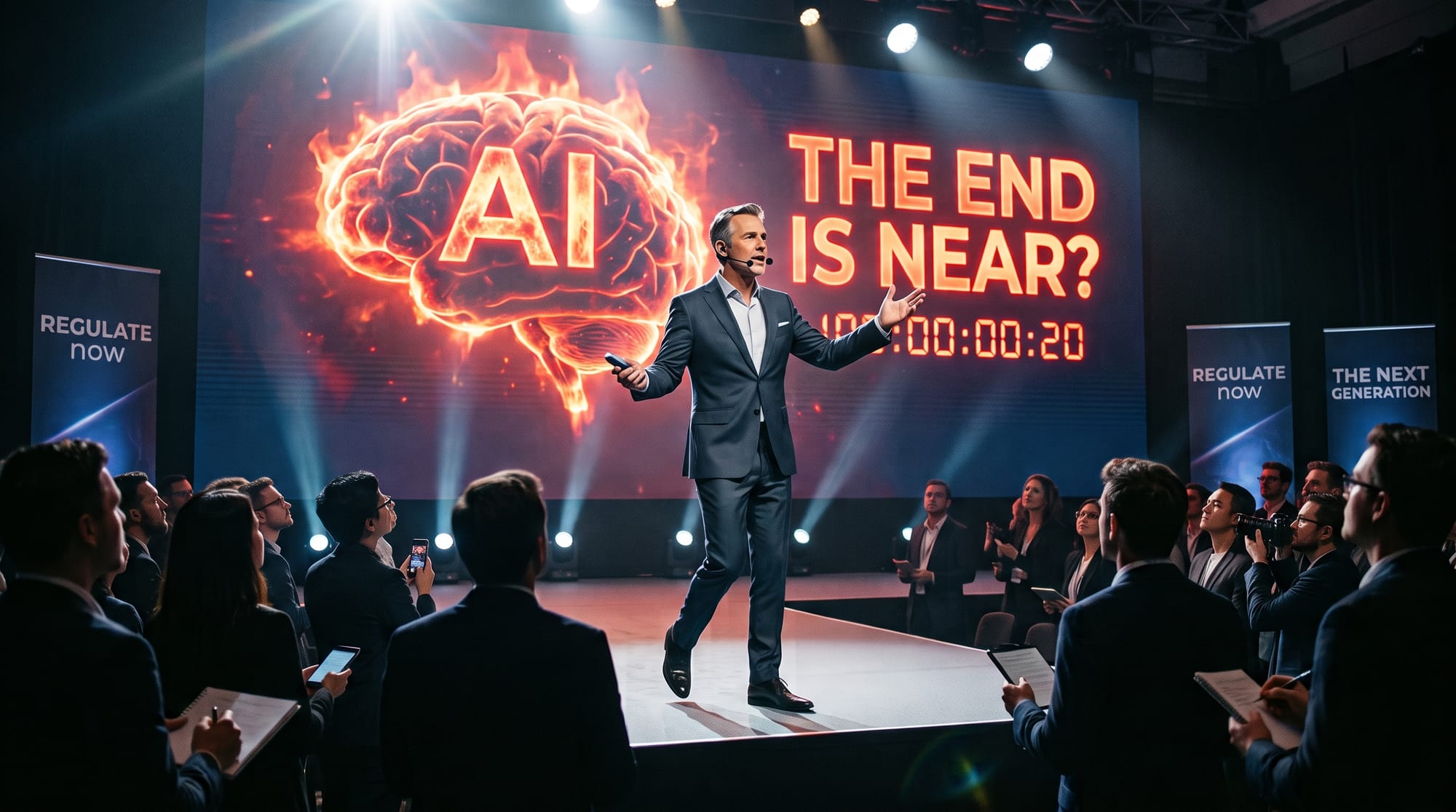
AI doom is fear-mongering. At the end of the day, AI is a tool, and tools don't wake up and decide to end the world.
Every few months a new warning lands: the next model is too dangerous, the clock is ticking, we have a decade left. A recent CBS poll shows it's working. 43% of Americans want AI companies to slow down, 12% want them to stop entirely, and 44% want to keep the current pace or speed up. Half the country thinks these models will probably or certainly harm humans.
I've been building infrastructure for over a decade, and I run AI workloads in my business every day. I don't see a monster. I see a very capable tool with real limits. So I want to ask a different question: who benefits when you're scared?
The moat is drying up
The big labs have a problem, and it isn't rogue AI. It's that their advantage is shrinking fast.
Back in 2023, a leaked memo from inside Google said it plainly: "We have no moat, and neither does OpenAI." That wasn't only about rival AI labs. It was about everyone. Building something useful with a language model used to take a research budget only a handful of corporations could fund. Today a mid-size company, or a guy with a decent GPU, can run an open-weight model locally and get real work done.
And here's the part the pitch decks skip: you don't need a trillion-parameter frontier model for most tasks. Summarizing a contract, sorting invoices, drafting an email, tagging camera footage. A local model handles that fine, on your own hardware, with your data never leaving the building. The gap between "frontier" and "good enough" is closing every quarter.
Fear is a business strategy
So if you're a giant AI company watching your lead evaporate, what do you do? You can't out-engineer open source forever. But you can make the rules.
Picture licensing regimes, mandatory safety audits, compute thresholds and compliance teams. Every one of those costs millions. OpenAI, Google and Microsoft can absorb that. A startup in Miami can't. A small business running a fine-tuned model on a local server definitely can't.
That's the play. Scare the public enough and have lawmakers build a wall, and the only companies that can afford to climb it are the ones already inside. It's called regulatory capture, and it's an old trick. The doom narrative is just the newest marketing for it.
Regulation only stops people who follow rules
Let's say the fear is real. Say a model really could be turned into something dangerous. Does heavy regulation stop that?
No. Bad actors don't file compliance report. A hostile state lab, a criminal crew or a scammer running stolen weights isn't waiting for a license. The open models are already out there, and you can't unrelease them.
So who does regulation actually slow down? The good actors. The researchers publishing their work, the small firms building honest products, the schools and hospitals trying to adopt this responsibly. You tie their hands and leave the field to the people who never cared about the rules in the first place.
We've heard this before
People's memories are short. We've been through this cycle already, more than once.
In 2019, OpenAI held back the full version of GPT-2 because it was supposedly too dangerous to release. GPT-2 couldn't write a coherent page. In 2023, a big open letter called for a six-month pause on training anything more powerful than GPT-4. The warnings were dire.
The pause never happened. We are now far past GPT-4 in capability, and the world didn't end. What we got instead were better coding tools, better search and better document processing. Everytime, the line of "too dangerous" moves forward to whatever comes next, and every time the thing we were warned about becomes something we use at work on a Tuesday.
No, they haven't built AGI
Here's my simple test. If any of these labs had built true general intelligence, they would at least be profitable. A system that can do any job a human can do would print money. Instead, the biggest names are still burning billions and raising the next round.
Some researchers argue LLMs hit a hard mathematical ceiling. I don't buy that. What I see is a compute limit. Each response gets a fixed budget of work, and when a task needs more than that budget, the model guesses and you get a hallucination. That limit isn't math, and it isn't only cost. Today's hardware simply can't deliver the compute AGI would need. Even the labs, with every GPU they can buy, are running into power, memory and chip limits. The ceiling hasn't been reached; the hardware just isn't there yet.
You can see that ceiling in practice. Andon Labs' Vending-Bench 2 hands frontier models a simulated vending business to run for a year. The best models turn a profit, but they still land far below a human baseline, and they lose the thread over long stretches. That's not a god in a box. That's a very good assistant that still needs a manager.
The one rule we actually need
I'm not against all regulation. There's one rule I'd sign tomorrow: you can't instruct a model to do something dangerous and then blame the AI.
AI does nothing without instructions. Someone writes the prompt, builds the agent, wires it to the bank account or the email server, and hits run. If that system defrauds someone, harasses someone or causes real damage, the person or company who deployed it owns the outcome. Full stop.
We already do this with every other tool. If you aim a car at a crowd, you don't get to blame the car. Even Nvidia's Jensen Huang made a version of this point in his recent CBS interview: we already have laws for people who ship harmful products, so apply them. Make accountability the law, and you don't need a compliance moat that only billion-dollar companies can afford.
Where the other side has a point
I try to keep this blog honest, so here's where the worriers have merit. Serious researchers, not just marketers, believe the risks are real. And if I'm right that the limit is compute rather than math, these systems will keep getting more capable as compute grows. "AI only follows instructions" also gets harder to defend as agents run long chains of actions nobody reviews step by step.
I take those points seriously. But none of them changes my conclusion: the answer is accountability for the people who deploy these systems, not a regulatory wall that locks in today's giants.
The bottom line
AI is a tool. A powerful one, an imperfect one, and one that's getting cheaper and more local every month. That's exactly why the fear is so loud right now. When the moat dries up, the people standing behind it start telling you the water is dangerous.
Don't buy the doom. Learn what the tool actually does, keep a human in the loop, and hold whoever pulls the trigger responsible.