Kung Fu Robots and Air Acrobatics: Unitree's Standout Performance at the 2026 Spring Festival Gala

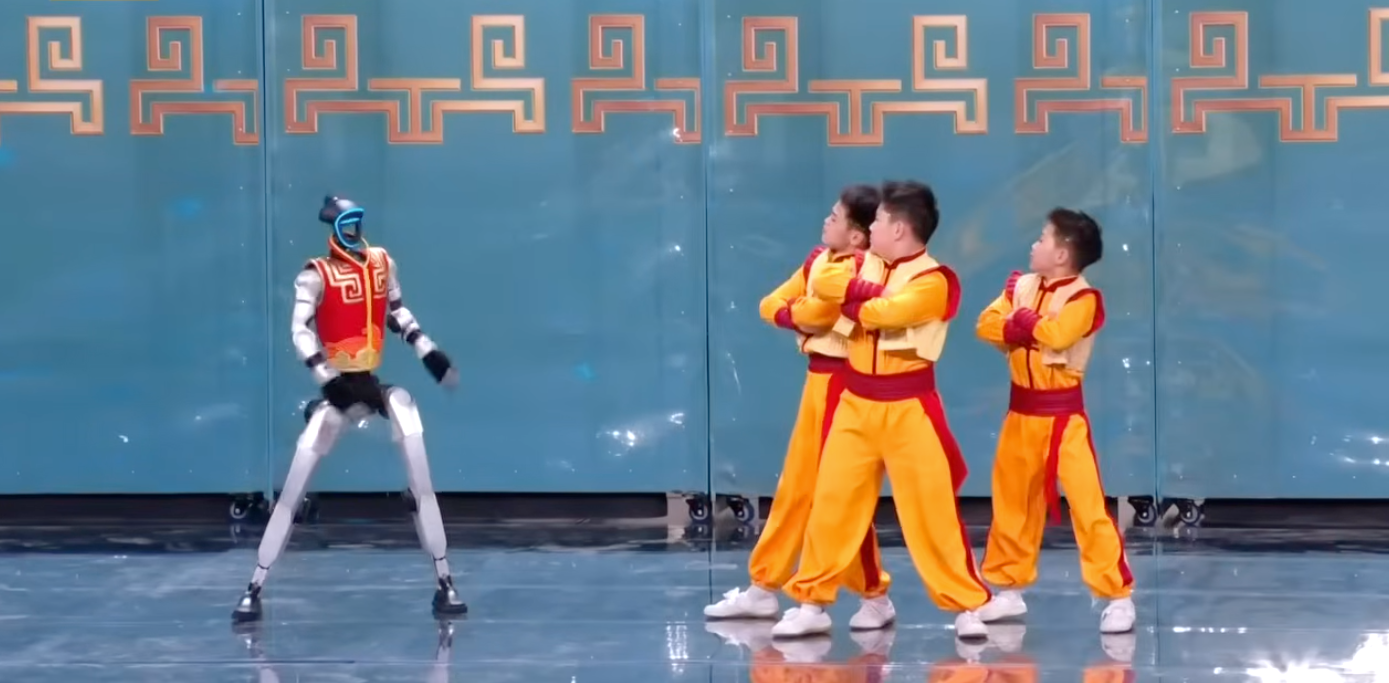
What Unitree pulled off at the 2026 CCTV Spring Festival Gala on Monday night had me shocked and wondering if it was CGI. The fluidity of the movement, the tool use mid-performance, the catapult-launched aerial flips several things stood out that I want to break down, because the engineering behind this performance deserves a closer look.
If you haven't seen it yet, Unitree's G1 and H2 humanoid robots performed a full martial arts routine called "WuBOT" alongside child performers from the Henan Tagou martial arts school. Nunchucks, swords, poles, drunken boxing sequences, parkour table vaults, wall-assisted backflips, and an airflare grand spin of seven-and-a-half rotations. All fully autonomous. All live on the most-watched television broadcast in China no reset button, no safety net.
Let's break down what actually happened and what it means.
The Catapult Launch: Engineering on Top of Engineering
One of the most jaw-dropping moments in the performance was the robots launching into three-meter aerial flips. In a post-performance interview with CCTV, Unitree CEO Wang Xingxing explained that the team spent about two months designing and building custom catapult launchers to make this possible. On flat ground, the robots can flip about one meter the catapults extended that to two or three meters.
What makes this impressive isn't just the height it's everything that has to happen after the launch.
When a catapult launches a robot three meters into the air, the system has to handle a cascade of problems that are fundamentally harder than anything on flat ground:
Uncontrolled launch dynamics Even with a custom-built launcher, the exact force profile, timing, and angle of each launch will have slight variations. The robot's control system can't just run a pre-computed trajectory. It has to sense its actual state mid-air and adapt. The G1's IMU and onboard sensors have to track orientation in real-time during free flight, with no ground contact for corrections.
Mid-air body reconfiguration To execute a flip while airborne, the robot has to manipulate its angular momentum by repositioning its limbs. This is the same physics that allows a cat to land on its feet or a diver to control their spin rate by tucking and extending. For a robot, this means real-time inverse kinematics calculations while ballistic adjusting joint angles to control rotation without any external contact point. Wang's team ran "hundreds of millions of training iterations" in simulation before moving to physical hardware. That's not a throwaway number that's reinforcement learning at serious computational scale.
Impact absorption on landing A three-meter launch means significantly more kinetic energy on the way down than a one-meter self-jump. The robot's leg actuators have to absorb that impact through compliant force control too stiff and the robot bounces or breaks hardware, too soft and it collapses. The G1 runs a 500 Hz control loop, giving it 2-millisecond response cycles to manage landing forces. The fact that these robots landed stably and continued performing tells you the hardware and the control algorithms are working together at a level that wasn't possible twelve months ago.
This is the same engineering philosophy behind human martial artists using springboards and trampolines for extreme aerial stunts the launch extends capability, and the aerial control and landing are where the skill lives. The robot's mid-air control and landing stability are the breakthrough here, and they delivered.
The Fluidity Problem And Why It's Mostly Solved
The thing that struck me most watching the performance wasn't any single stunt. It was the fluidity.
Go back and watch the 2025 Gala performance. The robots moved carefully. Deliberate. Cautious. They twirled handkerchiefs with the mechanical precision of a CNC machine accurate, but you could feel the robot in every motion. They needed human assistance to walk off stage.
Now watch the 2026 performance. The drunken boxing sequence alone is a masterclass in motion control. "Drunken boxing" deliberately mimics off-balance, stumbling movement which means the robot has to operate at the edge of its stability envelope while maintaining actual control. Simulating loss of balance while not actually losing balance is harder than just staying upright. It requires the underlying stability algorithms to be so robust that they can let the robot "play" near failure without actually failing.
The transitions between movements were smooth. Running into parkour vaults, weapon swaps, formation changes all without the jerky stop-start motion that's been the hallmark of humanoid robotics for years. Unitree reported that their high-speed cluster movements hit 4 meters per second (roughly 14 km/h) during formation transitions. Last year, the robots changed formations by walking slowly. That's a fundamental capability jump in twelve months.
One analyst described the shift well: the industry has moved from "pre-programmed puppets" to autonomous machines powered by robust stability algorithms. That's exactly what the fluidity shows. When every movement looks pre-calculated and rigid, you're watching playback. When movement looks natural and adaptive, you're watching a control system that understands dynamics. The 2026 performance looked adaptive.
Tool Use: The Detail Nobody's Paying Enough Attention To
The tool use in this performance deserves its own conversation.
The robots wielded swords, poles, and nunchucks throughout the martial arts routine. Unitree specifically highlighted their newly developed dexterous hands that support "rapid switching and stable gripping" of martial arts props. This wasn't a robot holding a stick this was robots transitioning between different weapons mid-performance while maintaining full-body dynamic balance.
Here's why this matters technically: holding a tool changes everything about the robot's dynamics. A sword shifts the center of gravity. Swinging a nunchuck creates oscillating forces that the control system has to anticipate and compensate for. The robot's internal model of its own body its understanding of where its mass is and how it moves has to update in real-time as the tool moves through space. Every swing, every strike, every transition to a new weapon means the robot is essentially recalibrating its physics model on the fly.
Now combine that with the drunken boxing choreography. The robot is deliberately moving in an unstable manner, while running in formation with a dozen other robots, while performing alongside human children. The stack of simultaneous control problems is not trivial.
And the force control element can't be overlooked. These robots were performing in close proximity to child performers. The force feedback systems had to be precise enough to swing weapons convincingly while guaranteeing safe interactions with nearby humans. Wang's team fine-tuned individual movements to the tenth of a second. That's the kind of precision that speaks to serious engineering discipline.
The Controlled Environment Caveat
Chinese technology analyst Patrick Zhang noted that the Spring Festival Gala provided an ideal stage controlled setting, flat surfaces, predictable airflow. "Robots may struggle in real-world environments, but on stage they hold all the advantages," he said.
He's not wrong. This was a choreographed performance on a known stage with rehearsed sequences. The robots weren't improvising. The catapults were custom-built for the venue. The formations were trained over months. This is not the same as dropping a robot into an unstructured factory and telling it to figure things out.
But here's the counterpoint: even Goldman Sachs, which published a skeptical analysis of the humanoid sector, acknowledged that the hardware capabilities on display are advancing faster than the "brains." The physical platform, the actuators, balance systems, force control, and mechanical durability, is approaching the point where the limiting factor is artificial intelligence, not hardware performance. That's a meaningful milestone. The body is ready; the mind needs to catch up.
The Numbers Behind the Show
Behind the kung fu spectacle, there's a commercial reality worth tracking:
Unitree shipped approximately 5,500 humanoid robots in 2025 and is targeting 10,000 to 20,000 units in 2026. China accounted for 90% of the roughly 13,000 humanoid robots shipped globally last year. Morgan Stanley projects Chinese humanoid sales will more than double to 28,000 units this year. Both Unitree and AgiBot are preparing IPOs.
Production costs are being driven below $20,000 per unit, what some analysts are calling the "EV-ification" of robotics, using supply chain scale to undercut competition before rivals finalize their designs. UBTECH and Unitree are leading this cost compression, leveraging the Pearl River Delta's component ecosystem to source nearly everything domestically.
Within minutes of the gala broadcast, JD.com listed multiple robot models for sale. Units from Unitree, MagicLab, and Noetix sold out almost immediately. The gala isn't just a tech showcase, it's a product launch event with a billion-person audience.
My Honest Take
The 2026 Gala performance was a showcase of how far humanoid robotics has come in twelve months, and several things stood out to me:
The catapult-launched aerial flips with stable landings, engineering layered on top of engineering. The fluid, naturalistic movement quality, especially the drunken boxing stability control. The real-time tool manipulation while maintaining dynamic balance. The high-speed cluster coordination at 4 m/s with seamless formation changes. The force-controlled interactions in close proximity to human child performers. And the sheer fact that all of this ran live, autonomously, without visible failure, on national television.
The jump from handkerchief twirling to armed martial arts formations in twelve months is the kind of progress curve that should have every robotics company in the world paying attention. Not because of the kung fu, but because of what the underlying control systems had to achieve to make the kung fu possible.
Just like the catapult launched robots into the air, this is also a launch for robotics to the forefront of the global conversation. The future is here. And I'm here for it.